Bringing Together a Crew Advice Form for Clarity and Compliance
Feel free to search our website, in particular for our Crew Advice Form. It saves a lot of heartache and headaches later.
Click here: SAILORS CREW ADVISE FORM.
"Having regularly used international customs and immigration throughout the world as crew for 20-years, this remains an ‘unqualified research and observation article’.
I would warmly welcome any feedback from those more qualified in this area to help provide an approach to the challenge facing budget-conscious cruisers. I am not endorsing or sponsored by any products mentioned in this article...James

Why Controversial Medical Topics Must Be Addressed in Crew Advice Forms
Controversial topics such as COVID-19 and vaccination requirements and other historical or regulatory immunisation standards are also addressed within crew declarations, as many countries require documented printed proof of vaccinations prior to entry.
Complications can arise where friends/crew member claims to hold valid certification, but is later unable to produce it, or where documentation is found to be invalid or fraudulent. In such cases, resolution may take days or even weeks, creating significant sailing delays.
This raises an important question:
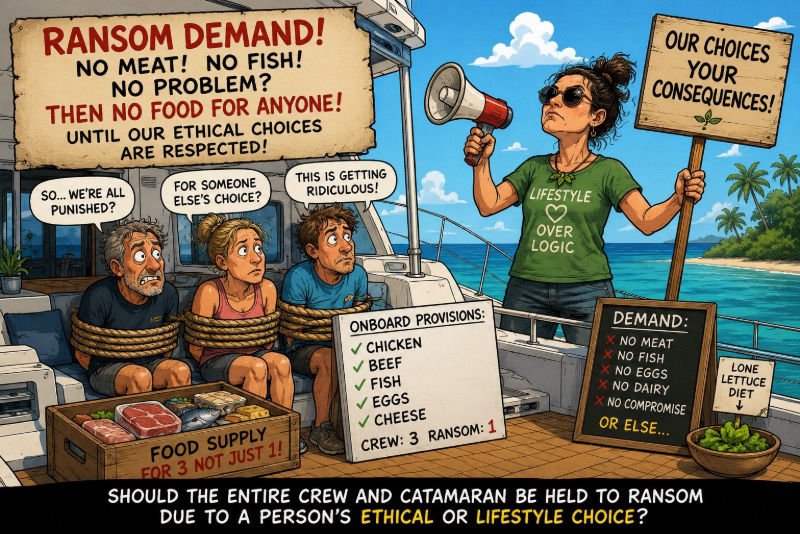
Should the entire crew and vessel be held to ransom due to a person's ethical or lifestyle choice?
It also highlights the question of how we, as the vessel owner, ensure legal protection when operating in foreign jurisdictions under such circumstances. These scenarios can, and are accounted for in advance through clear documentation and agreed procedure.

How Crew Advice Forms Cover Both The Individual and Vessel Owner
An agreement that covers every scenario is not what we are trying to achieve here. There are, however, a few topics that can be rounded into a few questions that cover the legal duty of care and responsibility by the vessel owner.
The document addresses (beyond hearsay) questions such as:
1. How can we ensure that a friend/crew member understands that the duties are voluntary and not for a reward?
2. How can we mandate certain understandings without being or sounding offensive?
3. What legal power does the vessel owner have to remove a person from their vessel, in particular in a foreign country?
4. If a crew member refuses to leave the vessel in a foreign country, where do the owner and/or individual stand legally?
5. If Authorities request a search of an individual member's bags and find an illegal weapon, drugs or contraband, where does the vessel owner's duty of care end?
Why Requesting Medical History Is Hugely Important Onboard
Having an accurate understanding of a person’s current and past medical history can be critical, not only in protecting their health but also in providing essential guidance to untrained crew during a medical emergency.
Do you currently, or have you previously, suffered from any medical conditions that we need to be aware of? YES / NO
Why? - There have been instances where friends have answered “NO” to this question, only to experience medical incidents onboard, including:
1. A severe asthma attack, and
2. A cardiac event requiring medication.
The events ended safely; however, that was due to someone having an Advanced Medical First Aid Certificate. These individuals were respectfully asked to leave the vessel for safety reasons, and have not spoken to us since.
This raises an important consideration: how should past conditions be assessed, for example, a resolved medical issue such as a collapsed lung from 20 years ago, and what level of disclosure is appropriate for safe and informed decision-making onboard?
Avoiding sensitive medical questions, including those relating to immunisations, asthma, heart conditions, head injuries, and other relevant health matters, is part of this query.

Formal Crew Advice Form Wording That Avoids Conflict
Simple YES or NO answers:
1. Are you aware that nuts, fish, meats, and poultry may be handled and stored onboard, and that galley equipment such as pots, pans, and utensils are used for multiple food types, with no separate catering for specific dietary requirements? YES / NO
Why? - These questions are intended to ensure prospective sailors are aware of onboard food practices and can confirm whether these align with their personal or medical dietary needs. You'd be surprised how many people expect the way you run the food practices on your vessel to change because they have a specific dietary requirement.
2. Are you comfortable assisting in cleaning and cooking all foods, particularly those mentioned above? YES / NO.
Why? - Some don't like handling raw meats, which is fine if the whole vessel does not have raw meats. Some don't like washing up.
3. Have you forwarded three copies of your Offshore Insurance? YES / NO.
Why? - (a) This ensures all parties have read the Form. (b) This indirectly ensures that everyone has Offshore Insurance.
The Legal Value of a Well-Structured Crew Advice Form
There are numerous examples of vessel owners facing serious operational problems because members misunderstood what was expected of them, or later refused to leave the vessel after disagreements arose onboard.
Other situations involve crew members demanding payment for duties that were never discussed or agreed upon prior to departure.
International travel can create even greater complications. If a crew member arrives at a foreign port without meeting that country’s visa or entry requirements, the captain may be held solely responsible.
In some cases, authorities may refuse permission for that person to disembark the vessel. This can leave the owner and captain facing significant delays, legal complications, and difficult operational decisions.

The Psychological Purpose of a Crew Advice Document
The document can be confrontational, as it includes private matters such as visa requirements, medical and health obligations, insurance responsibilities, and an acknowledgement that the crew member is responsible for planning ahead for these eventualities.
It is a Form of Declaration (as it is signed and dated). Look at it as a Prenuptial Agreement.
The reciprocal, however, is that it also serves as a useful checklist for all members, helping them prepare for onboard requirements and professional expectations before joining the vessel.