Preparing a Yacht for Offshore Sailing: 3 Years to 6 Months Out
Part: 1 of 4 - (3 years out to 12 months out)
Planning a five-month South Pacific sailing season requires more than choosing a departure date and plotting a few destinations. Weather windows, cyclone seasons, crew, provisioning, maintenance, insurance, customs, communications and yacht reliability all need to work together.
Our preparation began well before departure. We used a long-term plan to progressively prepare the yacht, train the crew, test major systems and build the documentation needed for international cruising. By departure, the objective was simple: spend less time solving preventable problems and more time sailing.
This article is broken into 4 PARTS. It explains how we approached the overall five-month plan, throughout the South Pacific, and how the major decisions fitted together.
We Started Three Years Out: Building a Plan
Our biggest advantage was time. We broke the preparation into manageable annual goals rather than trying to complete everything immediately.
Over three years, we completed major upgrades, maintenance and system improvements while still using the yacht. This gave us the opportunity to test equipment in real conditions and identify problems before committing to extended offshore passages.
During this period, we also completed two separate five-month Coral Sea voyages.
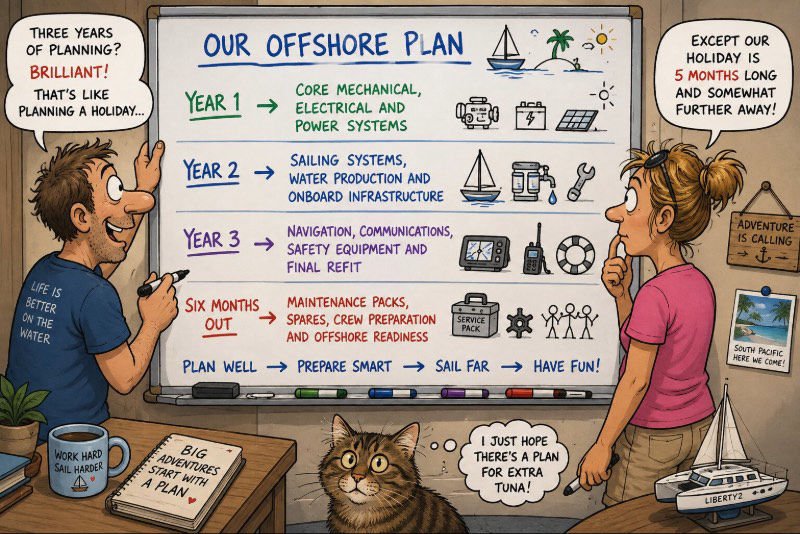
The plan was divided into four stages:
Year 1: Core mechanical, electrical and power systems
Year 2: Sailing systems, water production and onboard infrastructure
Year 3: Navigation, communications, safety equipment and final refit
Six months out: Maintenance packs, spares, crew preparation and offshore readiness
This approach also made insurance requirements, training and documentation easier to manage because each major task was completed and recorded progressively.
Do Yourself a Huge Favour: Document Everything
Good documentation became one of the most useful parts of our preparation. We started building records early and continued updating them throughout the refit.
The aim was simple: create a central reference for:
> Yacht systems,
> Maintenance procedures,
> Emergency information, and
> Equipment locations.
Instructions were written so another crew member could follow them without needing the captain standing beside them. Procedures included tasks such as changing a propeller, locating circuit breakers and replacing batteries.
Offshore, the key question was:
If you were injured or unable to assist, could your crew safely operate the yacht?
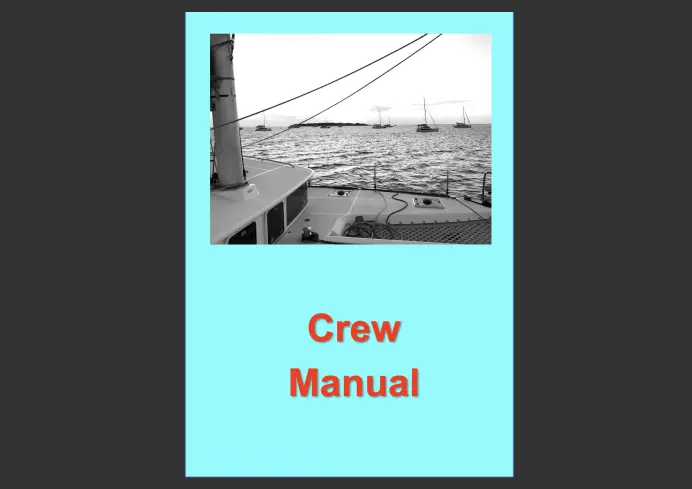
Our answer was to develop a detailed onboard CREW MANUAL, supported by a CREW DECLARATION covering responsibilities, training and operational requirements.

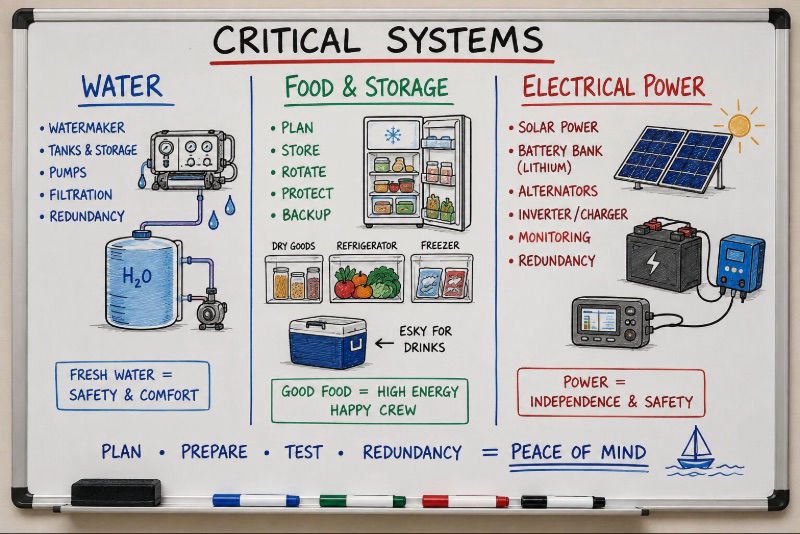
Plan Food Storage With Power
Food storage and electrical planning are closely connected.
We divided provisions into four categories:
> Frozen food
> Refrigerated food
> Dry goods
> Fresh produce
Battery capacity needed to support refrigeration and freezer loads continuously, with a 30% reserve. Hot tropical conditions and frequent access to the fridge can significantly increase energy consumption.
We also used an external esky for drinks and water, reducing unnecessary access to the main refrigerator.
Consider what happens if refrigeration fails. Long passages and remote anchorages leave little opportunity to replace spoiled food or repair equipment quickly.
We discuss in more detail in Part 2 about our OFFSHORE PROVISIONING, and provide a downloadable document of our OFFSHORE PROVISIONING LIST.

Build a Proactive Maintenance Program
Major systems were installed early enough to be tested over time. This allowed us to learn how each system behaved, identify weak points and develop practical backup procedures.
A structured maintenance schedule then kept servicing and consumable replacement on track.
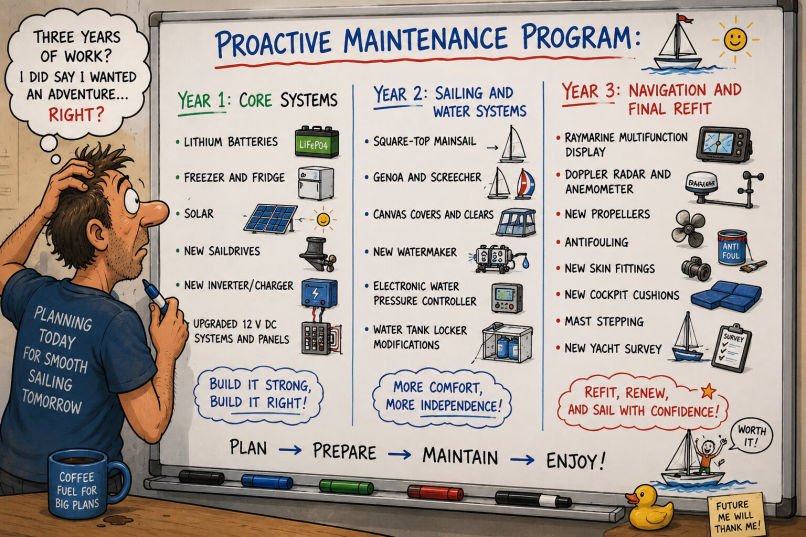
Year 1: Core Systems
The first year concentrated on major electrical and mechanical upgrades, including lithium batteries, Isotherm freezer and fridge, 1.9 kW solar, new saildrives, new inverter/charger, and upgraded 12 V DC systems and panels.
Year 2: Sailing and Water Systems
The second year focused on sailing equipment, weather protection and water systems: square-top mainsail, genoa and screecher, canvas covers and clears, new watermaker, electronic water pressure controller, water tank locker modifications.
Year 3: 🧭 Navigation and Final Refit
The final major refit year concentrated on navigation, propulsion and structural maintenance: Raymarine multifunction display, doppler radar and anemometer, Gori propellers, antifouling, new skin fittings, ew cockpit cushions, mast stepping, and yacht survey.
Create Maintenance Service Packs
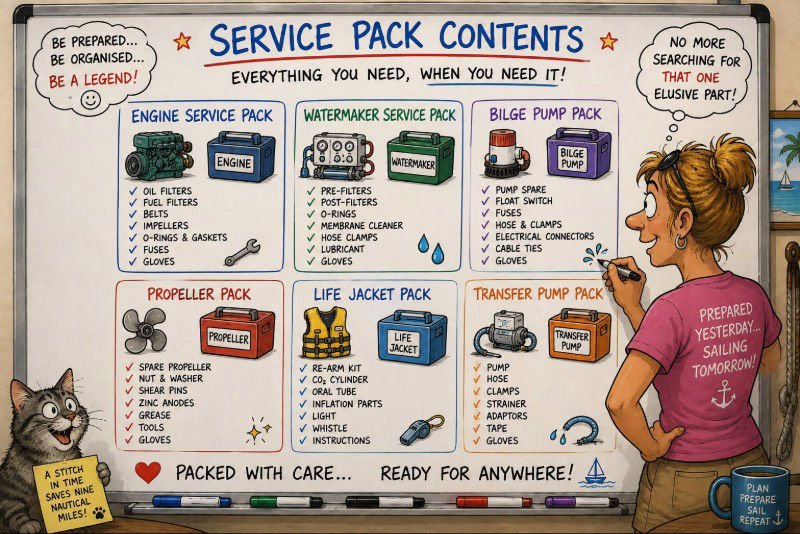
By the later stages of the preparation, we began turning individual maintenance jobs into pre-prepared Service Packs.
Each pack contained the required consumables, spare parts, disposable gloves, relevant tools and a simple checklist. Contents were sealed in zip-lock bags to protect them from moisture and corrosion.
Examples included:
> Engine service pack
> Watermaker service pack
> Bilge pump pack
> Propeller pack
> Life jacket pack
> Transfer pump pack
The objective was to avoid searching through storage lockers for individual parts when a service or repair was required offshore.
Review Insurance and Medical Cover
Insurance should be considered well before departure, particularly when international waters are involved.
Our planning covered four areas:
> Local-water yacht insurance
> International-water yacht insurance
> Personal medical insurance
> Offshore medical and evacuation cover
Standard health insurance may contain exclusions relating to injuries sustained aboard private vessels in international waters, while medical evacuation can also be excluded.
These conditions need to be checked against your actual cruising plans rather than assumed.
Identifying Critical Offshore Systems
Offshore passages depend on critical systems that must remain reliable when assistance is unavailable. Fresh water, electricity, communications, and food storage each require equipment that is tested and reliable, well-designed, properly maintained, and supported by a practical backup.
Year 1: 💧 Water
Fresh water is a critical offshore resource. Your tanks, watermaker, pumps and filtration systems need to operate reliably throughout the passage. Tank water should be split and at least one tank isolated. This tank becomes the reserve for equipment failure or an extended period without water production. The remaining tank should carry sufficient water for drinking, cooking and hygiene.
Year 2: ⚡ Electricity
Reliable electricity supports navigation, refrigeration, communications, lighting, autopilot and essential onboard equipment.
A well-designed offshore electrical system needs adequate generation, battery capacity, monitoring and redundancy. Solar generation, lithium batteries and efficient power management can reduce dependence on engines and protect essential systems during long passages.
Year 3: 📡 Communications
Offshore communications provide weather information, emergency contact and access to assistance when required. Maintain independent communication methods such as VHF, satellite communications and other suitable systems.
Test equipment before departure and ensure the crew understand how to use each system during normal operations and emergencies.
Year 4: 🍽️ Food & Storage
We have already discussed.