Passage Planning: Passage Planning beyond your next Passage

Part: 3 of 4 (6 months before departure)


Extended cruising changes the way you plan. A single offshore passage may last several days, but a South Pacific cruising season can involve repeated passages, remote anchorages, changing weather, limited supplies and long periods away from reliable marine services.

The plan therefore needs to extend beyond the next destination. Food, water, fuel, maintenance, spare parts, crew fatigue, communications and weather windows all become part of the passage-planning process. Our approach was to plan the cruising season in stages while keeping enough flexibility to change the route when weather or circumstances required it.

Plan Beyond the Next Passage

Once the initial passage is complete, where to next? Even the passage after the next passage.

Cruiser conversations often reveal useful details about whale and shark activity, ocean currents, reefs, anchorages and local conditions.

Following the fleet is not part of our cruising strategy. We make arrangements to catch up with other boats through WhatsApp a month or so later.
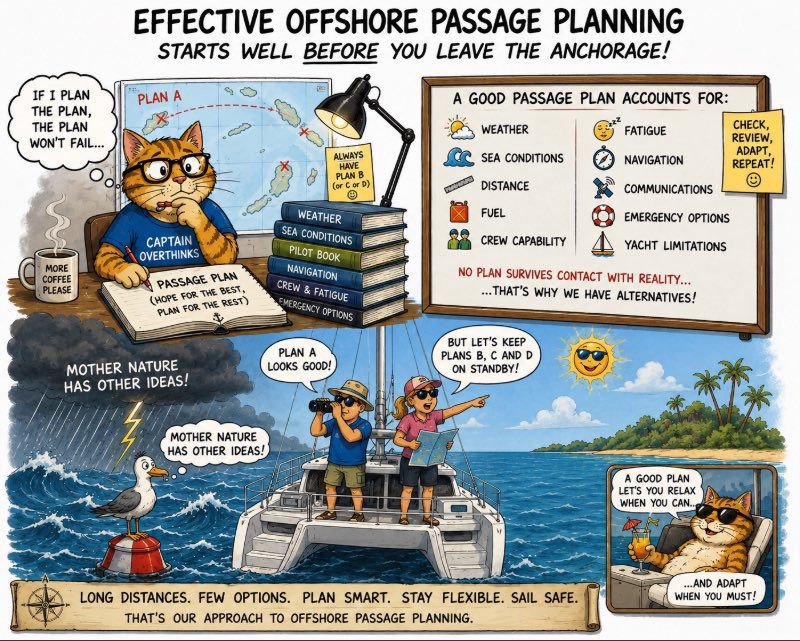
Comical: passage planning

Manage Weather Across the whole Cruising Season

We keep a close eye on South Pacific weather, changing trade winds, political developments, elections and medical alerts as the cruising season progresses.

Conditions, local requirements and weather patterns can change quickly, so today's plan may not be the plan you follow next month.

Visa Limits Can Dictate Your Cruising Plans
Visa restrictions are another major factor in South Pacific passage planning. Many countries provide around three months, but the exact allowance varies by nationality and destination. You must leave before your permitted stay expires.

For that reason, we start watching potential departure weather windows well before the visa deadline. By around the two-month mark, the weather forecast, prevailing winds, sea conditions and our remaining time in the country all become part of the decision.

Comical: couple worrying about remembering everything

Allow Time for Maintenance

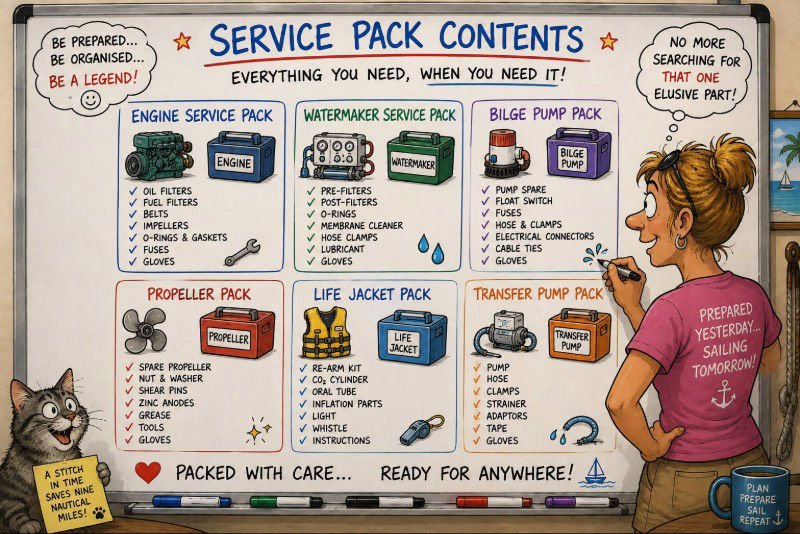
It is here that the Maintenance Service Packs we discussed in Part 1, come to the fore.

Previously Prepared Packs
Without rummaging through lockers, the consumables are at hand along with tools, spares and even a checklist. We then use the tough zip-lock bags as disposal bags.

Be proactive
Set time aside to check oils and general wear-and-tear. It's not the time to be dismantling items because 'you thought....'. Once done, log it in the Maintenance Log.

It's during these times that we also log the hull cleans and pest control, and even take video footage to prove to authorities our recorded proactive approach to Biosecurity, a major issue at incoming ports like New Zealand and Australia. You will be asked.
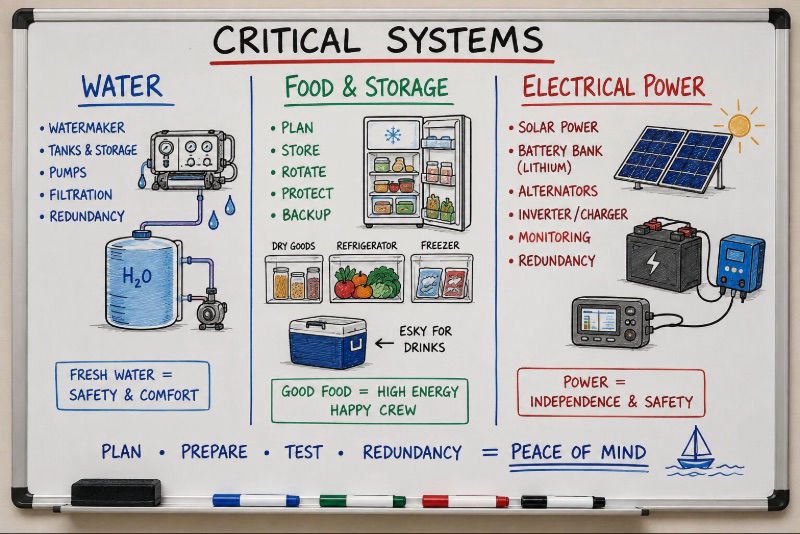
Drawing on whiteboard of critical systems

EMERGENCY MAP

This example should be printed (we use A4 size) and at least one copy displayed in an obvious place for all crew to see.

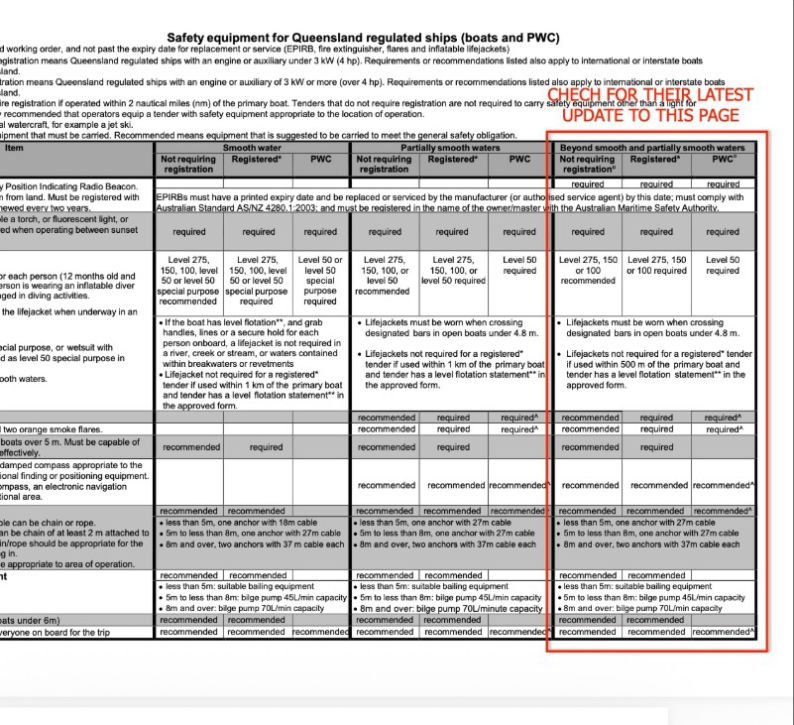
Additional Emergency Equipment Planning information can be accessed via this link.

Comical: Trying to fit beer in a fridge

OFFSHORE MEDICAL CHECKLIST FORM

This sample Shipboard Medical Register contains checklists & Inventory, and medical tracking. It was written in Numbers (or Excel). The framework is all-in-one, managing medical logs, annual medication updates, vessel storage locations, regulatory references, and formal control authorisations. The colour coding refers to the pouch colour the equipment is stored in.

This is a legal controlling document and should form part of your official Ships Library.

Comical: writing on a whiteboard

OFFSHORE MEDICAL CHECKLIST FORM

This sample Shipboard Medical Register contains checklists & Inventory, and medical tracking. It was written in Numbers (or Excel). The framework is all-in-one, managing medical logs, annual medication updates, vessel storage locations, regulatory references, and formal control authorisations. The colour coding refers to the pouch colour the equipment is stored in.

This is a legal controlling document and should form part of your official Ships Library.

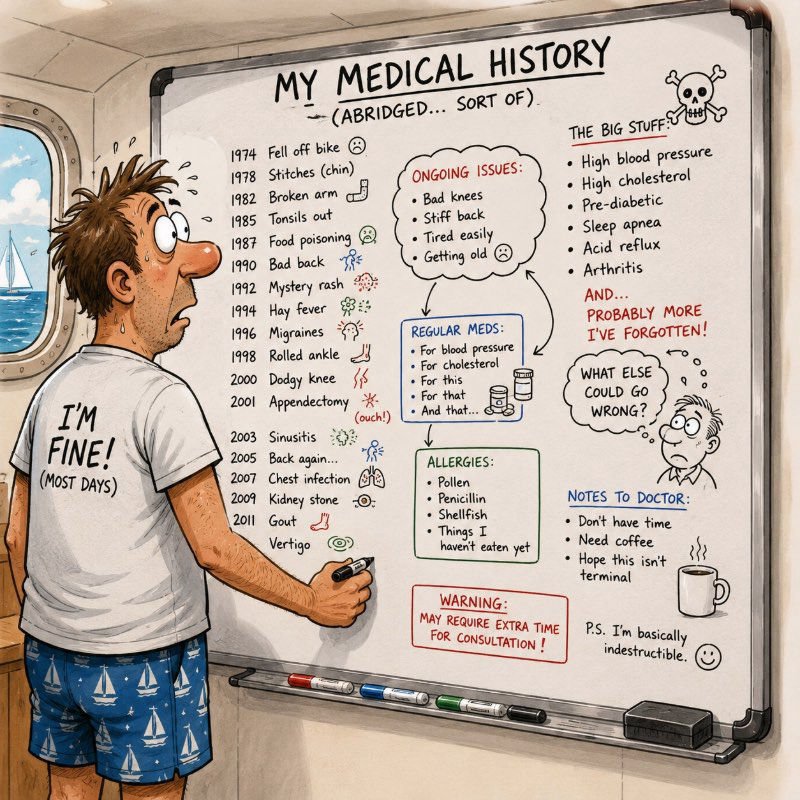
Comical: Man writing his medical history

Preparation: Essential 6 Months out Consideration & Completion Tips

MSQ Emergency Equipment

Insurers and First Aid: Reducing Liability Through Preparedness

Medical evacuations from the middle of the ocean can cost tens, or even hundreds of thousands of dollars.

In many situations, the skipper may be held financially liable unless responsibilities and liabilities have been clearly documented in advance.

That’s one of the key reasons a Crew Declaration is so important for offshore sailing.

What catches many cruisers off guard is that standard travel insurance policies often exclude incidents occurring aboard a private yacht in international waters. Always read the fine print carefully and look specifically for exclusions relating to “private yacht” or offshore passages.

Securing yacht insurance can also be challenging. Before coverage is approved, insurers typically require a detailed marine survey to assess the vessel’s condition, seaworthiness, and overall safety standards.

In countries such as New Zealand, and increasingly Australia, insurers are also paying closer attention to crew qualifications, safety training, and onboard compliance procedures.

For sailors over 50, cardiovascular health becomes an even greater consideration offshore. Automated external defibrillators (AEDs), together with current CPR and resuscitation training, are rapidly becoming essential safety equipment for extended voyages.

As a result, a dedicated marine first aid course is no longer simply a good idea — it’s becoming an essential part of responsible offshore preparation.

This all contributes to the classic insurance dilemma many sailors face: feeling “damned if you do, damned if you don’t,” where every decision involves balancing safety, liability, cost, and complex policy conditions.

This takes 6 months to sort out, in particular the Crew Declaration.

Add Insurance and First Aid to your TO DO LIST your offshore cruising TO DO list.

Every Offshore Crew Needs a Proven Man Overboard Recovery Plan

If you weigh more than 75kg and become the MOB (man overboard), your crew must be capable of recovering you quickly and safely — especially offshore, where swell, fatigue, and panic can rapidly turn a survivable incident fatal.

Talking about MOB procedures is not enough. Under stress, people forget. What crews really need is a documented recovery plan supported by realistic practice and training. Start in calm water and simply try boarding your yacht without steps — it quickly reveals how difficult real recovery can be.

We originally carried a Dan Buoy system, but after experiencing offshore swell conditions, we upgraded to a Jon Buoy recovery system. That experience completely changed our thinking about offshore MOB recovery. Locating the casualty is only the beginning, getting them back onboard is often the hardest part.

The idea of trailing a line aft of the vessel, is nonsense. Watch this video, they are only doing 4kts in calm seas.

1. Could you (in a split second) swim back, and grab a trailing rope at 4kts?
2. How do you make a recovery after braking your arm from the overboard fall?
3. This man (in the video) struggles to hold on, most people (clothed), can't!
4. Ever thought about how to swim with a lifejacket on offshore. Can you swim on your front?

There are a lot of takeaways from this video, especially if your other crew member is not confident and has little strength to complete a recovery out of the water.

This should be documented somewhere, to cover any litigation and Insurance inquiries. We use our Crew Manual.

Add both MOB recovery planning and formal crew documentation to your offshore cruising TO DO list.

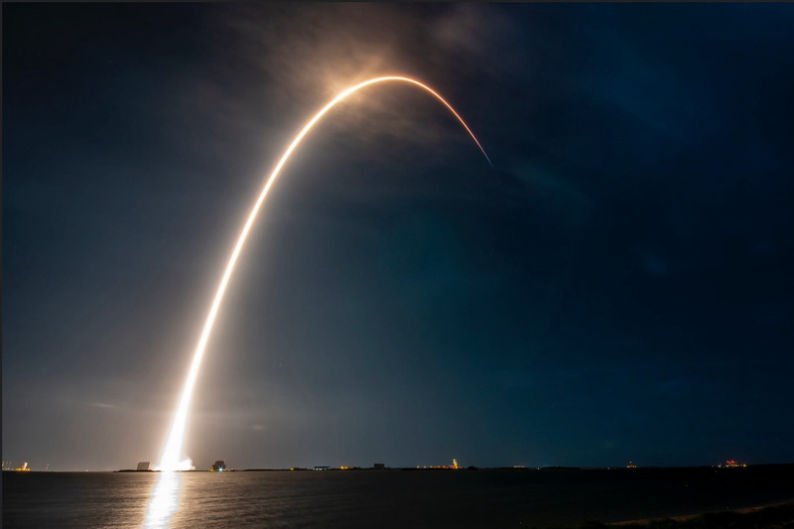
Starlink: launching satellites into space

Offshore Sailing Communications: Safety Beyond Mobile Coverage

Safety, safety, safety.... Satellite communications have changed offshore cruising, and for us, embracing the technology is essential.

Once you leave reliable mobile coverage behind, satellite internet becomes an important part of staying connected, accessing weather information and communicating with family, friends and other cruisers.

HF communications remain alive and well, but very few yachts are taking the HF option anymore. The cost of the install compared to that of satellite is chalk and cheese.

Systems such as SpaceX’s Starlink and Iridium GO! now provide offshore crews with far greater connectivity, improved emergency communications, weather access, and real-time contact even in the most remote parts of the ocean.

Despite these advances, traditional marine communication systems still play a critical role onboard.

Fixed and handheld VHF radios remain essential equipment for both coastal cruising and offshore passages, providing reliable short-range communication for vessel traffic, marina access, emergency calls, and onboard safety procedures.

For serious offshore sailing, the safest approach is not choosing one system over another, but building a layered communications setup that combines satellite technology with proven marine radio systems.

Offshore Sailing Footage in the Remote Coral Sea Outcrops

This footage was captured during an offshore passage approximately 200–250 nautical miles from the Australian coastline. At this distance, we’re well into the Coral Sea, far beyond coastal cruising range. Not many people realise just how remote this part of the ocean really is when you’re that far offshore.

Start at the outer edge of the Great Barrier Reef and then head even further out to sea — roughly double that distance offshore.

At that range, you’re deep in remote ocean territory where land left you a day before and conditions feel completely isolated. These locations are so remote they’re barely distinguishable on standard Google Maps.

© Copyright 2009 - [JS_CODE_0] diycatamaran.com - All Rights Reserved